Showing posts with label France. Show all posts

Thursday, September 26, 2013

Swap Meet

Many parts of the world have passed from one country to another, some a great deal of times.  But the most frequent sovereignty flip-flopper is certainly Pheasant Island along the border between France and Spain, which has been exchanged between the two at regularly scheduled intervals for the past 350 years.

In 1659, France and Spain had been at war for the past quarter century, and were ready to sign a peace treaty, but they needed an agreeable, neutral location in which to do so.  They met at Pheasant Island, a tiny piece of land in the middle of the Bisaboa River which forms part of their common border.  Obviously, the most important thing about a treaty ending decades of brutal war is who gets to claim credit for hosting the peace summit.  To avoid any imbalance on this key issue, it was agreed that the island would become a condominium - a piece of land over which two countries share control.

Usually, a condominium is simply jointly administered, with both countries simultaneously contributing to governing it.  However, in 1659, kings signing treaties were pretty much free to agree on whatever crazy scheme they wanted, and the countries instead decided that the island should swap back and forth every six months.  To understand how silly of a plan this is, it's important to know that, aside from a little monument marking the location of the treaty and a handful of trees, the island is empty.  It's too small to have any real significance or value.

Still, the two powers managed to find another use for it aside from signing treaties.  Dating back even before the 1659 treaty, the island had been used to exchange brides between the two royal families.  In 1615, Louis XIII of France and Phillip IV of Spain met on the island and exchanged sisters.  Louis married Philip's sister Anne, and Philip married Louis' sister Elisabeth.

Although the sister swaps have stopped now that France no longer has a monarchy, the shared custody of the island continues to the present day, making Pheasant Island the oldest condominium on the planet.  Since 1659 it has changed hands over 700 times.

Wednesday, September 18, 2013

A Fly on the Wall

By the 1800s, the major powers had mostly decided that you couldn't just go about invading whoever you wanted on a whim - instead, you needed a justification (known as a 'casus belli') for an attack.  The problem with this was that everyone still wanted to go about carving up the world and painting the maps their color of choice.

In the 1820s, France looked across the Mediterranean, saw the ports of Algeria and said "man, I gotta get me some of that!"  The trouble was, they didn't have any particularly good reason why Algeria should be theirs - at least not besides the fact that France was big and who was going to stop them?  Luckily, there was a standing dispute between the nations that could be exploited - back in the 1790s France had contracted to purchase grain from some powerful merchants in Algeria, but had never paid.  The merchants, in turn, owed money to the ruler (called the Dey) of Algeria, and claimed they couldn't pay up until France paid them.

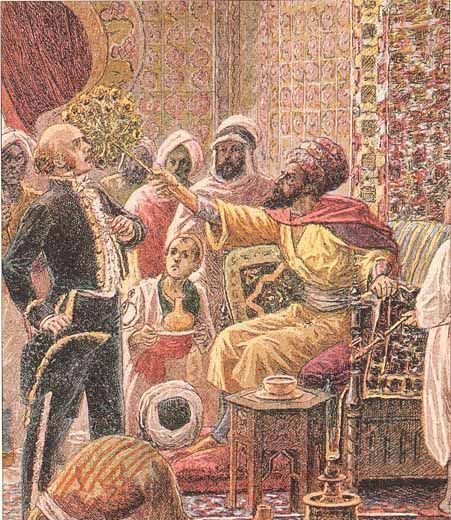
The argument over who should pay whom went back and forth for a few years before coming to a head at a meeting between the French ambassador and the Dey, in which the Dey became upset with ambassador's lack of answers, and smacked him with his fan/fly swatter.  As any schoolkid will tell you, "he hit me first!" is an excellent casus belli, and the French were not about to waste the opportunity.

After first blockading the Algeria ports for three years, they launched a full invasion in 1830 and began the occupation of the country.  It took decades of bloody war for French forces to establish control, and decades more to extend it deep into the desert territories.  And the French didn't half-ass the situation either: they went full-on brutal, oppressive colonial overlords.  One of the French commanders, Lieutenant-Colonel de Montagnac, wrote in 1843:

"All populations who do not accept our conditions must be despoiled. Everything must be seized, devastated, without age or sex distinction: grass must not grow any more where the French army has set foot. Who wants the end wants the means, whatever may say our philanthropists. I personally warn all good soldiers whom I have the honour to lead that if they happen to bring me a living Arab, they will receive a beating with the flat of the saber.... This is how, my dear friend, we must make war against Arabs: kill all men over the age of fifteen, take all their women and children, load them onto naval vessels, send them to the Marquesas Islands or elsewhere. In one word, annihilate all who will not crawl beneath our feet like dogs."

All this because someone got slapped with a fly swatter.

Tuesday, September 10, 2013

Sell Out

Thomas Palaiologos
The Byzantine Empire ended in 1453 with the fall of Constantinople and the death of Emperor Constantine XI Palaiologos, but the Palaiologos family wasn't about to give up the a title like Emperor of the Romans just because of a minor detail like that.  Constantine's nephews Demetrios and Thomas continued to claim the Byzantine mantle from their despotate in Morea.

After Demetrios defected to the Ottomans and Thomas died in exile following the capture of Morea, the claim passed to his son Andreas Palaiologos.  Although Andreas had no hope of recovering the empire from the Turks, he still titled himself the Emperor of Constantinople.  He lived in Rome under the patronage of the Pope, who provided him with a stipend to live on.  Either because he squandered the money or because it was simply not very much (historians disagree whether the Pope was providing him enough to live the "baller" lifestyle befitting an emperor), Andreas sought to find a way to parlay his title into some additional spending money.

First, he sold the rights of inheritance to the French king Charles VIII.  Presumably, Charles his successors were content to use the title to impress some medieval ladies, as they made no attempt to recover the territory to go with it.  Regardless, it provided Andreas with a nice sum of cash with which to live the life of an emperor-in-exile back in Rome.

Andreas turned out to not be particularly fiscally responsible, and burned through all the money from the sale in a few years.  Figuring that if selling a defunct title worked once, there's no reason it shouldn't work twice, he again sold the rights to Ferdinand and Isabella of Spain.  Andreas burned through this money as well, and died a pauper in 1502, despite having managed to sell the Byzantine Empire twice in a period of 8 years.

While this was all going on, his younger brother Manuel also decided to get in on the action, and traded the rights to title to the Ottomans in exchange for a hefty pension.  Thus, the last claimants of the Byzantine crown managed to sell it to three different monarchs, each time for a tidy profit.