Showing posts with label Byzantine Empire. Show all posts

Sunday, October 6, 2013

Nice Island, I'll Take It!

In 818, Emir Al-Hakam I of Cordoba faced a revolt from al-Ribad, one of the large suburbs of the city (at the time, Cordoba was one of the biggest cities in the world, having nearly half a million people).  The people were upset by Hakam's harsh tax policies, which he had enacted after the last revolt in 805, hoping to keep the people poor and helpless.

Unfortunately for the rebels, their attempt to storm the palace was easily defeated, and many of the mob were slaughtered in the streets.  After torturing and executing the ringleaders, Hakam took the extreme measure of rounding up and exiling every resident of al-Ribad, about 60,000 people.  Hakam was not one to put up with that kind of shit, apparently.  Most of the exiles moved to Morocco, but a large number, perhaps as many as 10,000, took up Mediterranean piracy.

Led by Abu Hafs, this pirate band, along with their families and their former neighbors, invaded and occupied the Egyptian city of Alexandria, intending to make it their new home.  The rulers of Egypt, of course, were not on board with this plan.  You can't just sail up to one of the most famous and important cities in the world and declare yourselves the new owners.

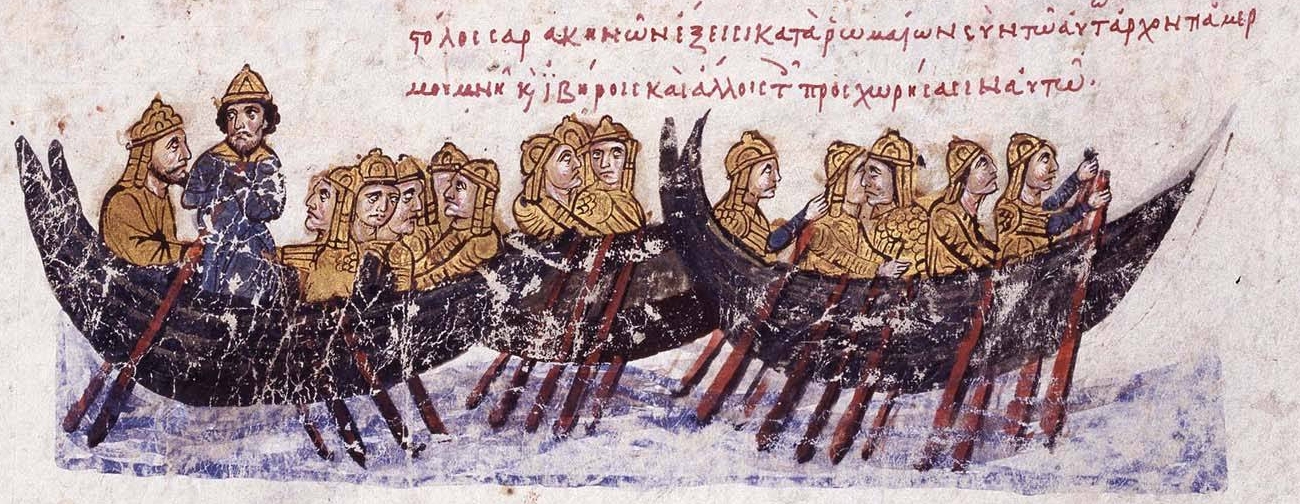
The Egyptians quickly marshaled their forces and besieged the city, reclaiming it about a year later.  So, the Cordobans set out again looking for a new home, and arrived at the island of Crete, then part of the Byzantine Empire.  After defeating the local garrisons, they set up shop on the island, and built the fortress of Chandax as their new capital.

Although the Byzantines sent several military expeditions to reclaim the island, the Cordobans successfully defended their new home for well over 100 years.  During that time, they launched raids across the Aegean sea, and occupied several smaller islands nearby.  It wasn't until 961 that Nikephoros II Phokas, one of the great generals of Byzantine history, and later a Byzantine Emperor, was able to retake Crete and drive the Cordobans out for good.  Today, over 1,000 years after their defeat, Chandax (now called Heraklion) remains the capital of the island.

Tuesday, September 10, 2013

Sell Out

Thomas Palaiologos
The Byzantine Empire ended in 1453 with the fall of Constantinople and the death of Emperor Constantine XI Palaiologos, but the Palaiologos family wasn't about to give up the a title like Emperor of the Romans just because of a minor detail like that.  Constantine's nephews Demetrios and Thomas continued to claim the Byzantine mantle from their despotate in Morea.

After Demetrios defected to the Ottomans and Thomas died in exile following the capture of Morea, the claim passed to his son Andreas Palaiologos.  Although Andreas had no hope of recovering the empire from the Turks, he still titled himself the Emperor of Constantinople.  He lived in Rome under the patronage of the Pope, who provided him with a stipend to live on.  Either because he squandered the money or because it was simply not very much (historians disagree whether the Pope was providing him enough to live the "baller" lifestyle befitting an emperor), Andreas sought to find a way to parlay his title into some additional spending money.

First, he sold the rights of inheritance to the French king Charles VIII.  Presumably, Charles his successors were content to use the title to impress some medieval ladies, as they made no attempt to recover the territory to go with it.  Regardless, it provided Andreas with a nice sum of cash with which to live the life of an emperor-in-exile back in Rome.

Andreas turned out to not be particularly fiscally responsible, and burned through all the money from the sale in a few years.  Figuring that if selling a defunct title worked once, there's no reason it shouldn't work twice, he again sold the rights to Ferdinand and Isabella of Spain.  Andreas burned through this money as well, and died a pauper in 1502, despite having managed to sell the Byzantine Empire twice in a period of 8 years.

While this was all going on, his younger brother Manuel also decided to get in on the action, and traded the rights to title to the Ottomans in exchange for a hefty pension.  Thus, the last claimants of the Byzantine crown managed to sell it to three different monarchs, each time for a tidy profit.

Wednesday, August 21, 2013

Cabbage Patch Emperors

One of the best parts of being a king is that you get an awesome nickname, like the "the Wise", "the Strong" or "the Great" (which usually requires making friends with the guy in charge of picking the nicknames).  Sometimes, though, you get stuck with one of the crappier names, like Louis the Stammerer of France, or Ethelred the Unready of England.

But one monarch in particular showed up way late to nickname assignment day, and really had to scrape the bottom of the barrel:  Emperor Ivaylo the Cabbage of Bulgaria.  In 1277, things were not going well for the Bulgarians.  Mongols were raiding from the North, the Byzantines were eyeing an easy conquest from the South, the economy was in shambles, and the peasants were, of course, getting uppity.  Ivaylo at the time was a lowly swine herder, but he would soon turn out to be perhaps the most uppity peasant of all time.

Ivaylo decided it was time for action, and styled himself as savior of the Bulgarian people, anointed by God to drive out the Mongol invaders.  Given that the crumbling government had driven out exactly zero Mongols, the people were pretty much willing to give anything a try and rallied behind him.  Ivaylo's newly formed peasant army was soon able to push back bands of Mongol raiders.  The Bulgarian Emperor, Constantine I, didn't like a lowly peasant showing him up, so he gathered his army, attacked, and was decisively defeated.  Constantine was killed in battle, leaving his 7-year-old son Michael Asen as the heir to the throne.  Ivaylo, however, married the widowed empress, and had himself crowned emperor.  This was presumably because if you're going to steal a child's crown, you might as well also bone his mother.

Unfortunately, both the Mongols and Byzantines soon grew tired of his antics, and when the full force of the Mongol army was arrayed against him, Ivaylo's mix of serf moxie and swine-herding skills was not enough.  He was driven back to his capital and besieged by the Mongolians.  After three months, he was able to break through the Mongol lines and resumed his string of improbable victories.  He even defeated two armies sent by the Byzantines who presumably didn't want their peasants getting any wise ideas.  In the meantime, though, the nobility of Bulgaria had gathered their forces together, and Ivaylo's army was too beleaguered to fight a third enemy.  He tried seeking refuge with the Mongols, but was assassinated by the khan.  Historians regard this as being a rookie mistake.

Despite his eventual defeat, Ivaylo holds the world record for most successful peasant uprising in European history.  Unlike every other attempt, he actually managed to be recognized as emperor, and led his armies to victories over two of the most powerful nations in history - the Mongol hordes and the Byzantine Empire.  Normally such a feat would earn one of the cool titles like "the Great" or "the Really Great", but the Bulgarians instead named him Ivaylo the Cabbage, because that's way funnier.