Showing posts with label Mongolia. Show all posts

Wednesday, October 2, 2013

You Don't Wanna Steppe To This

In the early 1600s, the Dzungar tribe of Western Mongolia sought to unify the neighboring tribal kingdoms under their rule.  The nearby Torghut and Dörbet, however, felt that to be "totally uncool, bro" and "a bit of a dick move," so they followed the example of other steppe nomads, and migrated.  Specifically, they headed all the way across Central Asia, and arrived at a patch of grazing land along the Volga River, just North of the Caspian.  Once there, they formed the Kalmyk Khanate.

The land that they settled was nominally under the control the Russian Empire.  The Kalmyks, who were Buddhists, were seen as a buffer against neighboring Muslim states, so the Russians were quite happy to let them stay - under nominal Russian authority, of course.  They even established trade agreements, and recruited Kalmyk horsemen for the Russian military.

As time went on, however, the Russians wanted to make that authority a little less nominal, and began chipping away at the Kalmyk autonomy.  By 1770, the head of Kalmyks, Ubashi Khan, decided that he was sick of Russia's crap, and said "Screw you guys, I'm going home".  After sending an emissary to Tibet to consult the Dalai Lama for approval and selection of an auspicious date of departure, Ubashi Khan set out in January 1771 with 200,000 of his countrymen (and an estimated 6 million herd animals) on a long walk back to Mongolia.  It was intended to bring the entire tribe, but an early melting of the Volga left some groups stranded on the Western side of the river.

Those left behind were probably fortunate, as the journey was not an easy one.  The Kalmyks had made enemies among the tribes across the steppe, and the Russians were not pleased with the departure.  Over half of the population was lost along the way, either to skirmishes with these enemies, or to starvation and exposure in the Siberian winter.

Those who remained in Russia lost their autonomy, but maintained many of their traditions, including Tibetan Buddhism and much of their nomadic lifestyle.  Neither of these sat well with Soviet authorities after the Russian revolution, and the Kalmyks saw their temples destroyed and their monks attacked.  Because of this harsh treatment, when the Nazis occupied Kalmykia during World War II, they found many willing to fight against the Soviets.  When the Soviets retook the area in 1943, they decided to forcibly deport the entire Kalmyk population, over 100,000 people, to Siberia as punishment.  Over half of those deported died in Siberia before being allowed to return in 1957.  Luckily, the Kalmyk people have experience with deadly migrations, forced or otherwise, and persevered.  Today, the Republic of Kalmykia within the Russian Federation is the only region of Europe in which Buddhism is the dominant religion.

Thursday, September 5, 2013

Stand Up For Yourself

By 1480, the Russian principalities had been paying more-or-less regular tribute to the Mongols and their successors for well over 200 years.  Ivan III, Prince of Moscow decided that was damn well long enough.  The Golden Horde (the Mongol successor state in Eastern Europe) was, of course, rather fond of the practice of having bags of gold dropped off every now and then, and so did not take this news well.  The Khan of the Golden Horde readied his troops, and marched against the Russians.

The two forces encountered each other in October of 1480 on opposite banks of the Ugra River.  The initial attempt by Khan Ahmed of the Horde to cross the river was rebuffed after a few days of skirmishing, so Ahmed decided to wait for additional troops to arrive from his ally, Casimir IV of Poland-Lithuania.  Meanwhile, Ivan III needed time to reconcile with his brothers, who were plotting against him while his army was occupied.

So, both sides bided their time, Ahmed waiting for Casimir and Ivan negotiating with his brothers, and then gathering their forces after coming to agreement, the whole time sitting just across the river from one another.  This situation persisted for weeks, and winter began to set in.  Ivan, not wanting to risk an assault across the river, decided to retreat to a winter camp a ways back from the banks.  Ahmed, seeing the no forces were coming from Poland (Casimir was involved in his own civil war), and suspecting that the Russians were luring him into a trap across the river, decided to retreat as well.     

The Russians decided that this totally counted, and celebrated their glorious victory against the Horde.  For his part, Ahmed was soon killed in battle against a rival Mongol faction.  The "Great Stand on the Ugra River" marked the end of Mongol influence in Russia - two armies stood across the river from each other, and then both went home without a fight.

Wednesday, August 28, 2013

Pen Pals

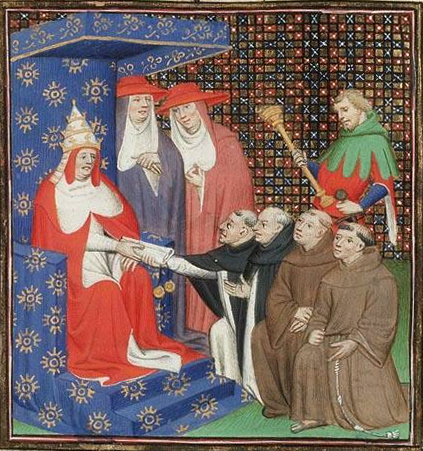
In 1246, Europe was pretty scared.  The Mongol horde had appeared out of the steppes of Asia, and seemed to be an unstoppable military force bent on destruction and conquest.  The Russian states had already fallen, and the armies of Eastern Europe were facing defeat.  Things were not looking good, and there seemed to be no hope of stopping the Mongolians from marching all the way to the shores of the Atlantic (and then, presumably, turning around and killing everyone a second time on their way back home).

Pope Innocent IV, being the leader of Catholic Europe, decided it was time for action.  Given that beating the Mongol armies back with force didn't seem to be working, he turned to the only other tactic available: a sternly-worded letter.  Innocent penned a letter to the Great Khan (Genghis was dead at this point, as was his son Ögedei, so his grandson Güyük was next in line), in which he took the opportunity to "...express in strong terms our amazement that you, as we have heard, have invaded many countries belonging both to Christians and to others and are laying them waste in a horrible desolation..."  He then proceeded to kindly ask the Mongols to cut the crap, saying, that he "...admonish, beg and earnestly beseech all of you that for the future you desist entirely from assaults of this kind..."

The Pope then gave the letter to a friar named Giovanni and sent him off to deliver it, which required travelling all the way from Rome to actual Mongolia - a trek of 3,000 miles which took them over 100 days, all for a letter which, for all they knew, may well have gotten them executed.

Güyük, as the two umlauts in his name would generally indicate, was not a man to be messed with.  The Pope's stern tone did not, as it turned out, convince him or his people to stop their conquering spree (which at this point had been going strong for 40 years), or to apologize for any feelings they may have hurt along the way.  Instead, Güyük sent the emissaries back with a letter of his own (the original copy of which is still in the Vatican archives), in which he interpreted the Pope's letter as an offer of submission, and demanded that the Pope and all the kings of Christendom personally travel to Mongolia so that they could bow before him.  The letter ended with a pretty clear threat: "If you fail to act in accordance therewith, how can we foresee what will happen to you? Heaven alone knows."

Güyük died only two years later, before he could make good on this threat.  Although the Mongols continued to menace Eastern Europe, they never returned with the same unstoppable force as they previously possessed.  Europe was spared, and the Pope never had to share the fate of the Islamic Caliph Al-Musta'sim whose similarly disobedient attitude resulted in him being wrapped in a rug and trampled to death by Mongol cavalry.

Wednesday, August 21, 2013

Cabbage Patch Emperors

One of the best parts of being a king is that you get an awesome nickname, like the "the Wise", "the Strong" or "the Great" (which usually requires making friends with the guy in charge of picking the nicknames).  Sometimes, though, you get stuck with one of the crappier names, like Louis the Stammerer of France, or Ethelred the Unready of England.

But one monarch in particular showed up way late to nickname assignment day, and really had to scrape the bottom of the barrel:  Emperor Ivaylo the Cabbage of Bulgaria.  In 1277, things were not going well for the Bulgarians.  Mongols were raiding from the North, the Byzantines were eyeing an easy conquest from the South, the economy was in shambles, and the peasants were, of course, getting uppity.  Ivaylo at the time was a lowly swine herder, but he would soon turn out to be perhaps the most uppity peasant of all time.

Ivaylo decided it was time for action, and styled himself as savior of the Bulgarian people, anointed by God to drive out the Mongol invaders.  Given that the crumbling government had driven out exactly zero Mongols, the people were pretty much willing to give anything a try and rallied behind him.  Ivaylo's newly formed peasant army was soon able to push back bands of Mongol raiders.  The Bulgarian Emperor, Constantine I, didn't like a lowly peasant showing him up, so he gathered his army, attacked, and was decisively defeated.  Constantine was killed in battle, leaving his 7-year-old son Michael Asen as the heir to the throne.  Ivaylo, however, married the widowed empress, and had himself crowned emperor.  This was presumably because if you're going to steal a child's crown, you might as well also bone his mother.

Unfortunately, both the Mongols and Byzantines soon grew tired of his antics, and when the full force of the Mongol army was arrayed against him, Ivaylo's mix of serf moxie and swine-herding skills was not enough.  He was driven back to his capital and besieged by the Mongolians.  After three months, he was able to break through the Mongol lines and resumed his string of improbable victories.  He even defeated two armies sent by the Byzantines who presumably didn't want their peasants getting any wise ideas.  In the meantime, though, the nobility of Bulgaria had gathered their forces together, and Ivaylo's army was too beleaguered to fight a third enemy.  He tried seeking refuge with the Mongols, but was assassinated by the khan.  Historians regard this as being a rookie mistake.

Despite his eventual defeat, Ivaylo holds the world record for most successful peasant uprising in European history.  Unlike every other attempt, he actually managed to be recognized as emperor, and led his armies to victories over two of the most powerful nations in history - the Mongol hordes and the Byzantine Empire.  Normally such a feat would earn one of the cool titles like "the Great" or "the Really Great", but the Bulgarians instead named him Ivaylo the Cabbage, because that's way funnier.