Showing posts with label Russia. Show all posts

Wednesday, October 2, 2013

You Don't Wanna Steppe To This

In the early 1600s, the Dzungar tribe of Western Mongolia sought to unify the neighboring tribal kingdoms under their rule.  The nearby Torghut and Dörbet, however, felt that to be "totally uncool, bro" and "a bit of a dick move," so they followed the example of other steppe nomads, and migrated.  Specifically, they headed all the way across Central Asia, and arrived at a patch of grazing land along the Volga River, just North of the Caspian.  Once there, they formed the Kalmyk Khanate.

The land that they settled was nominally under the control the Russian Empire.  The Kalmyks, who were Buddhists, were seen as a buffer against neighboring Muslim states, so the Russians were quite happy to let them stay - under nominal Russian authority, of course.  They even established trade agreements, and recruited Kalmyk horsemen for the Russian military.

As time went on, however, the Russians wanted to make that authority a little less nominal, and began chipping away at the Kalmyk autonomy.  By 1770, the head of Kalmyks, Ubashi Khan, decided that he was sick of Russia's crap, and said "Screw you guys, I'm going home".  After sending an emissary to Tibet to consult the Dalai Lama for approval and selection of an auspicious date of departure, Ubashi Khan set out in January 1771 with 200,000 of his countrymen (and an estimated 6 million herd animals) on a long walk back to Mongolia.  It was intended to bring the entire tribe, but an early melting of the Volga left some groups stranded on the Western side of the river.

Those left behind were probably fortunate, as the journey was not an easy one.  The Kalmyks had made enemies among the tribes across the steppe, and the Russians were not pleased with the departure.  Over half of the population was lost along the way, either to skirmishes with these enemies, or to starvation and exposure in the Siberian winter.

Those who remained in Russia lost their autonomy, but maintained many of their traditions, including Tibetan Buddhism and much of their nomadic lifestyle.  Neither of these sat well with Soviet authorities after the Russian revolution, and the Kalmyks saw their temples destroyed and their monks attacked.  Because of this harsh treatment, when the Nazis occupied Kalmykia during World War II, they found many willing to fight against the Soviets.  When the Soviets retook the area in 1943, they decided to forcibly deport the entire Kalmyk population, over 100,000 people, to Siberia as punishment.  Over half of those deported died in Siberia before being allowed to return in 1957.  Luckily, the Kalmyk people have experience with deadly migrations, forced or otherwise, and persevered.  Today, the Republic of Kalmykia within the Russian Federation is the only region of Europe in which Buddhism is the dominant religion.

Sunday, September 29, 2013

Not Quite Israel

The Russian Empire, as the name suggests, was an Empire for Russians.  However, because of its vast territory, it contained many areas in which other ethnicities were the local majority.  These areas often faced mistreatment from the Russian authorities, and were seen as foreigners even in their own homelands.

One of the promises of the Bolshevik revolution was that these various minorities would gain autonomy and self-determination in the Soviet state, which helped the revolutionaries find recruits among non-Russians.  Once the Empire was overthrown, it was time to make good on the promise.  Because the new Soviet authorities didn't want territories to start seceding left and right, they came up with a system by which each recognized nationality would receive a semi-autonomous state within the union.

While some nationalities had clear historical identities, languages, territories, etc. others were trickier.  Some were heavily divided along tribal lines, and had little nationalistic desire.  Others lacked things like a written language or a shared culture.  One of the trickiest cases was the Jewish population - they had all of the qualifications except for a historical territory within the country.

In 1928, a solution was found.  As a quick glance at a map will tell you, Russia has more territory in Siberia than it knows what to do with, so a patch of land along the far eastern border with China was selected as a new Jewish homeland.  Although this might seem like a strange and arbitrary choice of location, it had a few key benefits for the Soviet government.  First, it was felt that creating a Jewish homeland somewhere in the European part of the country would only exacerbate the antisemitism among the population.  Second, the Siberian border regions were largely unsettled, and the hope was that the Jewish territory would provide much-needed development and protection.

For obvious reasons, not many Jews were keen on the idea of abandoning their homes and trekking thousands of miles to the Siberian wilderness.  By 1948, 30,000 Jews had moved to the region, many fleeing mistreatment under Stalin.  After the establishment of Israel, the majority emigrated, and only around 2,000 Jews remain today.

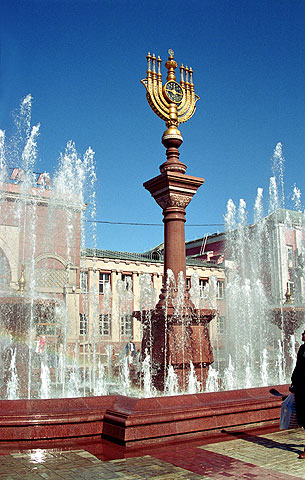
Although most of the Jewish population has left, the cultural institutions remain.  In the Jewish Autonomous Oblast, the local schools teach Yiddish, Yiddish radio and newspapers are in operation and children learn about Jewish history and traditions.  The capital Birobidzhan features statues of Jewish cultural icons, and a giant menorah sits in the town square.

Thursday, September 5, 2013

Stand Up For Yourself

By 1480, the Russian principalities had been paying more-or-less regular tribute to the Mongols and their successors for well over 200 years.  Ivan III, Prince of Moscow decided that was damn well long enough.  The Golden Horde (the Mongol successor state in Eastern Europe) was, of course, rather fond of the practice of having bags of gold dropped off every now and then, and so did not take this news well.  The Khan of the Golden Horde readied his troops, and marched against the Russians.

The two forces encountered each other in October of 1480 on opposite banks of the Ugra River.  The initial attempt by Khan Ahmed of the Horde to cross the river was rebuffed after a few days of skirmishing, so Ahmed decided to wait for additional troops to arrive from his ally, Casimir IV of Poland-Lithuania.  Meanwhile, Ivan III needed time to reconcile with his brothers, who were plotting against him while his army was occupied.

So, both sides bided their time, Ahmed waiting for Casimir and Ivan negotiating with his brothers, and then gathering their forces after coming to agreement, the whole time sitting just across the river from one another.  This situation persisted for weeks, and winter began to set in.  Ivan, not wanting to risk an assault across the river, decided to retreat to a winter camp a ways back from the banks.  Ahmed, seeing the no forces were coming from Poland (Casimir was involved in his own civil war), and suspecting that the Russians were luring him into a trap across the river, decided to retreat as well.     

The Russians decided that this totally counted, and celebrated their glorious victory against the Horde.  For his part, Ahmed was soon killed in battle against a rival Mongol faction.  The "Great Stand on the Ugra River" marked the end of Mongol influence in Russia - two armies stood across the river from each other, and then both went home without a fight.

Sunday, August 18, 2013

Makhnovia

http://en.wikipedia.org/wiki/File:RPAU_flag.svg
After the Russian Revolution in 1917, a band of revolutionaries lead by Nestor Makhno established an anarchic society in Southeastern Ukraine.  This wasn't your normal podunk commune of a few dozen unwashed hippies.  The Free Territory had 7 million residents, a military over 15,000 and possibly the most badass flag in history which featured a skull and the motto "Death to all who stand in the way of freedom for a working people!"  In other words, they took this shit serious.

In fact, they took things a little too seriously for the liking of the Russian Red Army.  Makhno's territory banned all political parties, including the Bolsheviks (who were more accustomed to doing the banning), and forbade any participation in Soviet militias, police, or any other authoritarian force.  This did not go over well.

Deciding that Makhno was too communist for his own good, the Bolsheviks branded him a bandit warlord.  After a few years of attacks, they succeeded in destroying his army, occupying the territory, and sending Makhno into exile in Paris.  He would later work as a stage hand for the Paris opera, because what other job are you going to get with "leader of a revolutionary anarchic army" on your resume?