Sunday, September 29, 2013

Not Quite Israel

The Russian Empire, as the name suggests, was an Empire for Russians.  However, because of its vast territory, it contained many areas in which other ethnicities were the local majority.  These areas often faced mistreatment from the Russian authorities, and were seen as foreigners even in their own homelands.

One of the promises of the Bolshevik revolution was that these various minorities would gain autonomy and self-determination in the Soviet state, which helped the revolutionaries find recruits among non-Russians.  Once the Empire was overthrown, it was time to make good on the promise.  Because the new Soviet authorities didn't want territories to start seceding left and right, they came up with a system by which each recognized nationality would receive a semi-autonomous state within the union.

While some nationalities had clear historical identities, languages, territories, etc. others were trickier.  Some were heavily divided along tribal lines, and had little nationalistic desire.  Others lacked things like a written language or a shared culture.  One of the trickiest cases was the Jewish population - they had all of the qualifications except for a historical territory within the country.

In 1928, a solution was found.  As a quick glance at a map will tell you, Russia has more territory in Siberia than it knows what to do with, so a patch of land along the far eastern border with China was selected as a new Jewish homeland.  Although this might seem like a strange and arbitrary choice of location, it had a few key benefits for the Soviet government.  First, it was felt that creating a Jewish homeland somewhere in the European part of the country would only exacerbate the antisemitism among the population.  Second, the Siberian border regions were largely unsettled, and the hope was that the Jewish territory would provide much-needed development and protection.

For obvious reasons, not many Jews were keen on the idea of abandoning their homes and trekking thousands of miles to the Siberian wilderness.  By 1948, 30,000 Jews had moved to the region, many fleeing mistreatment under Stalin.  After the establishment of Israel, the majority emigrated, and only around 2,000 Jews remain today.

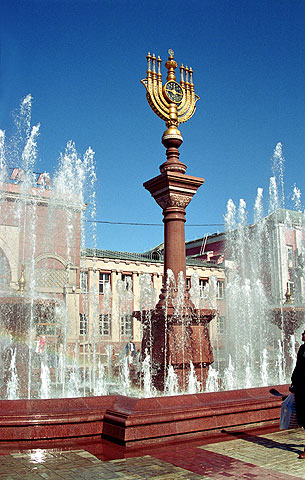
Although most of the Jewish population has left, the cultural institutions remain.  In the Jewish Autonomous Oblast, the local schools teach Yiddish, Yiddish radio and newspapers are in operation and children learn about Jewish history and traditions.  The capital Birobidzhan features statues of Jewish cultural icons, and a giant menorah sits in the town square.

Thursday, September 26, 2013

Swap Meet

Many parts of the world have passed from one country to another, some a great deal of times.  But the most frequent sovereignty flip-flopper is certainly Pheasant Island along the border between France and Spain, which has been exchanged between the two at regularly scheduled intervals for the past 350 years.

In 1659, France and Spain had been at war for the past quarter century, and were ready to sign a peace treaty, but they needed an agreeable, neutral location in which to do so.  They met at Pheasant Island, a tiny piece of land in the middle of the Bisaboa River which forms part of their common border.  Obviously, the most important thing about a treaty ending decades of brutal war is who gets to claim credit for hosting the peace summit.  To avoid any imbalance on this key issue, it was agreed that the island would become a condominium - a piece of land over which two countries share control.

Usually, a condominium is simply jointly administered, with both countries simultaneously contributing to governing it.  However, in 1659, kings signing treaties were pretty much free to agree on whatever crazy scheme they wanted, and the countries instead decided that the island should swap back and forth every six months.  To understand how silly of a plan this is, it's important to know that, aside from a little monument marking the location of the treaty and a handful of trees, the island is empty.  It's too small to have any real significance or value.

Still, the two powers managed to find another use for it aside from signing treaties.  Dating back even before the 1659 treaty, the island had been used to exchange brides between the two royal families.  In 1615, Louis XIII of France and Phillip IV of Spain met on the island and exchanged sisters.  Louis married Philip's sister Anne, and Philip married Louis' sister Elisabeth.

Although the sister swaps have stopped now that France no longer has a monarchy, the shared custody of the island continues to the present day, making Pheasant Island the oldest condominium on the planet.  Since 1659 it has changed hands over 700 times.

Saturday, September 21, 2013

Pop Pop!

In World War I, we didn't have fancy satellites and drones to keep tabs on enemy positions.  That work had to be done by a dude with binoculars and a radio sitting somewhere high up.  In many instances, this meant putting him in a basket and strapping it to a giant hydrogen-filled balloon so he could float above the battlefield and report what he saw.

Just as there were guys whose job it was to sit in the balloon, there were guys on the enemy side whose job it was to stop them.  These 'balloon busters' would fly in low in biplanes and attempt to shoot down the observation balloons with incendiary rounds.  While it might sound like a dude in a wicker basket beneath a giant stationary balloon filled with explosive gas would be a pretty easy target for a fighter plane with specialized ammunition, the task was actually quite dangerous for the balloon busters.  Observation balloons were valuable assets, and their owners would devote significant resources to their defense, including ground-based anti-air installations and fighter plane escorts.

The greatest of these balloon busters was the Belgian Willy Coppens, who shot down a whopping 35 German balloons (as well as two enemy airplanes) between April and October of 1918.  In one of his most remarkable attacks, the balloon he was targeting was loosed from its moorings, and rose up beneath his plane.  He shut off his propeller to avoid tangling it in the fabric of the of damaged balloon, and sat parked on top of it until his plane slid off and he could fly away to safety.

As he racked up more victories, Willy became a prime target for the Germans, who set up special traps to take him out.  In one instance, they booby-trapped a balloon with explosives, so that when he shot it down, the resulting explosion would be enough to take his plane down with it.  He narrowly escaped, of course, because he was a badass.

In October 1918, less than a month before the end of the war, he was severely wounded when an incendiary round hit him in the leg as he secured his final balloon destruction.  He managed to crash land behind friendly lines, but his leg had to be amputated, ending his career as a pilot.  He died in 1986 at the age of 94.  As an old man, he probably went around to children's birthday parties and popped their balloons with a pea shooter.

Friday, September 20, 2013

Ladder to Heaven

One of the most important holy sites of Christianity is the Church of the Holy Sepulchre in Jerusalem.  It's believed to be built atop the location where Jesus was crucified, as well as the cave of his burial and resurrection.  Like everything important in Jerusalem, control of the church has been a hotly contested issue for centuries, with the various major Christian denominations fighting (sometimes via literal combat) for administrative authority.

Back in the 600s, Caliph Omar, one of the companions of Muhammad, was invited by the Christian Patriarch to pray inside the church.  He declined and instead prayed a nearby so as to preserve the church's status as a Christian holy site.  This precedent meant that the various Muslim authorities who would rule Jerusalem for much of the next 1400 years were often neutral arbiters, forced to settle the disputes of the various Christian factions.

Early on, control of the front door was given to the local Muslim Nusaybah clan, who are to this day (along with a second family, the Joudeh) in charge of unlocking and opening the gate every day.  Meanwhile, the inside the church has been the site of fierce and violent battles for control of the various holy sites.  Monks of the various orders fought each other with stones and staffs, and bribed and cajoled the Muslim authorities to take sides.  In 1757, a mob of Greek Orthodox launched a surprise attack to take over the entire building.  The Catholic Franciscans barricaded themselves inside, but were eventually overrun and thrown out.

The conflict nearly grew to a major war in 1853 when Napoleon III of France demanded that the Ottomans restore the pre-1757 arrangement, but Tsar Nicholas I of Russia threatened to invade the Ottomans if they did so.  The situation was defused (if one can call it that) by an Ottoman decree that the present status quo would remain in effect, and could not be changed.  The Greek Orthodox Church would possess the majority of the power, while the Catholics and Armenians would hold smaller responsibilities.  The Coptic, Ethiopian and Syraic Churches also have minor authorities.

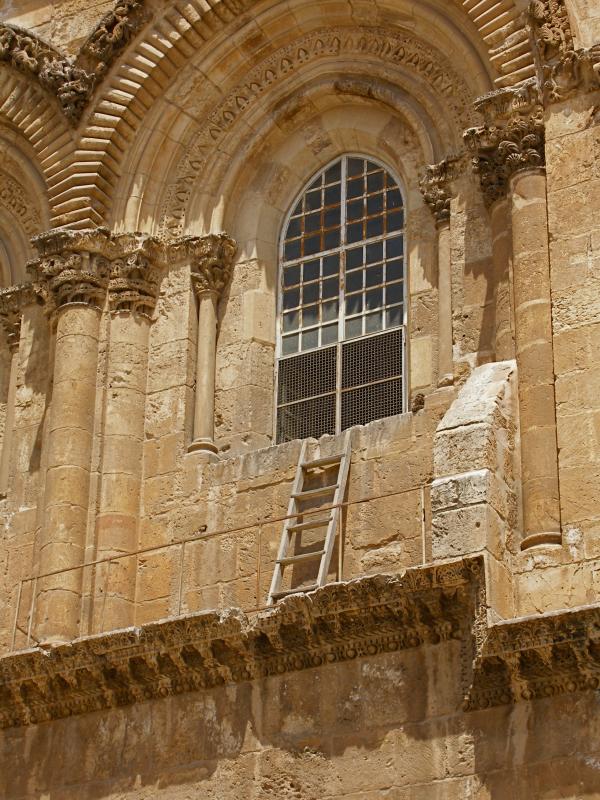
The adherence to this status quo is so strict that even trivial changes require the approval of all parties involved.  Because everyone refuses to get along, this tends to result in failure to accomplish the most minor of tasks.  One of the most notorious is a small ladder, which was resting against a window at the time of the Ottoman decree.  Because the window ledge is common ground, moving the ladder would require the approval of all six of the orders.  It has therefore remained propped against the window for over 150 years.  (It was moved briefly in 1997, probably without authorization, but quickly replaced).

In 2002, eleven monks were hospitalized after a Coptic monk moved his chair into a few feet into the shade, the Ethiopians disapproved, and a brawl broke out.  Theologians agree this is almost certainly what Jesus would have done.

Wednesday, September 18, 2013

A Fly on the Wall

By the 1800s, the major powers had mostly decided that you couldn't just go about invading whoever you wanted on a whim - instead, you needed a justification (known as a 'casus belli') for an attack.  The problem with this was that everyone still wanted to go about carving up the world and painting the maps their color of choice.

In the 1820s, France looked across the Mediterranean, saw the ports of Algeria and said "man, I gotta get me some of that!"  The trouble was, they didn't have any particularly good reason why Algeria should be theirs - at least not besides the fact that France was big and who was going to stop them?  Luckily, there was a standing dispute between the nations that could be exploited - back in the 1790s France had contracted to purchase grain from some powerful merchants in Algeria, but had never paid.  The merchants, in turn, owed money to the ruler (called the Dey) of Algeria, and claimed they couldn't pay up until France paid them.

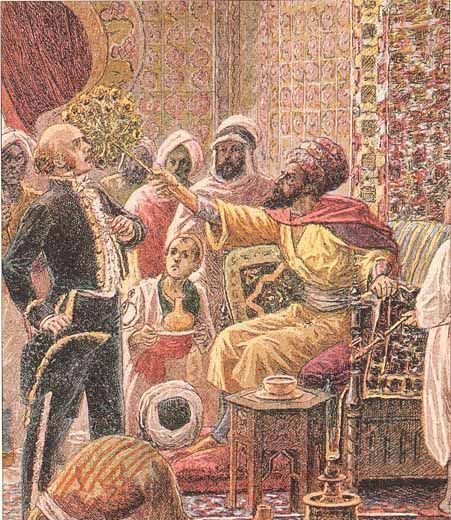
The argument over who should pay whom went back and forth for a few years before coming to a head at a meeting between the French ambassador and the Dey, in which the Dey became upset with ambassador's lack of answers, and smacked him with his fan/fly swatter.  As any schoolkid will tell you, "he hit me first!" is an excellent casus belli, and the French were not about to waste the opportunity.

After first blockading the Algeria ports for three years, they launched a full invasion in 1830 and began the occupation of the country.  It took decades of bloody war for French forces to establish control, and decades more to extend it deep into the desert territories.  And the French didn't half-ass the situation either: they went full-on brutal, oppressive colonial overlords.  One of the French commanders, Lieutenant-Colonel de Montagnac, wrote in 1843:

"All populations who do not accept our conditions must be despoiled. Everything must be seized, devastated, without age or sex distinction: grass must not grow any more where the French army has set foot. Who wants the end wants the means, whatever may say our philanthropists. I personally warn all good soldiers whom I have the honour to lead that if they happen to bring me a living Arab, they will receive a beating with the flat of the saber.... This is how, my dear friend, we must make war against Arabs: kill all men over the age of fifteen, take all their women and children, load them onto naval vessels, send them to the Marquesas Islands or elsewhere. In one word, annihilate all who will not crawl beneath our feet like dogs."

All this because someone got slapped with a fly swatter.

Friday, September 13, 2013

Chinny Chin Chin

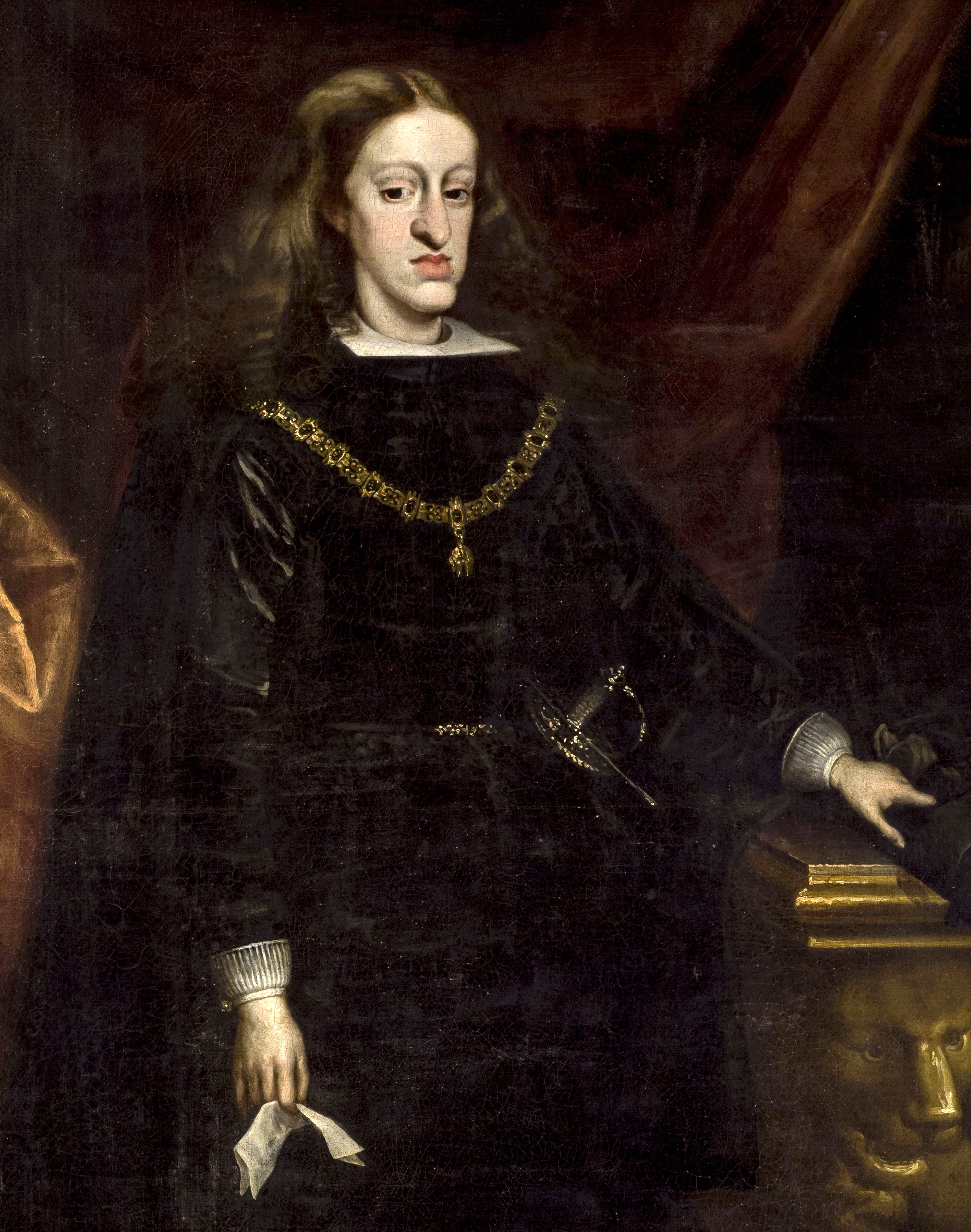
What happens when your family tree is circle?  Beginning in the 1500s, the Habsburg family set to find out.  For over 100 years, the descendants of Philip I and Joanna of Castille married only among themselves to prevent other families from gaining claims on Habsburg titles.  The process culminated in Charles II of Spain, son of Philip IV and his niece Mariana (this was hardly the only instance of uncle-niece marriage in Charles' ancestry).  Charles' lineage was so intertwined that he was more inbred than the offspring produced by siblings.  This was not good.

The Habsburg line was famous for the pronounced chin that ran in the family, but in Charles this feature manifested as a miserable deformity, as his jaw was so far forward that he could neither chew nor speak intelligibly and drooled uncontrollably.  His handicaps were both physical and mental, and the young Charles did not learn to walk until he was eight years old, and was not capable of receiving any manner of schooling.  He was incapable of being king in every sense, but, since this was medieval Europe, he was king none the less.

Due to the staggering degree to which Charles was unfit to rule, the actual administration of the Spanish Empire fell to the nobles of the court, who spent much of their time jockeying for power and influence while the economy crumbled around them.  Charles' reign (insofar as playing children's games while a country collapses counts as a 'reign') was disastrous for Spain.

The one problem that only Charles could fix was that he was the last of the Spanish Habsburg line, and had to produce an heir or the family would go extinct.  The task of mating with the disfigured drooling imbecile fell to the 16 year old Marie Louise of France (who was at least a mildly distant relative).  She fell into a deep depression and died some years later, without producing any children (it is pretty likely Charles was infertile).  A second marriage to Maria Anna of Neuburg similarly failed to produce offspring.

When Charles died in 1700, the Spanish Habsburgs died with him, and the War of the Spanish Succession was fought to determine who would inherit his crown.  His autopsy report said that his body "did not contain a single drop of blood," which modern scientists consider to be "the stupidest thing I've ever heard."

Wednesday, September 11, 2013

Baptistest

Mississippi has a lot of Baptists - 55% of the population, making it the most Baptist state in the US.  However, it's only the second most Baptist state in the world.  First place goes to an isolated mountainous state in the very far Northeast of India called Nagaland, where a solid 75% of the population is Baptist.

For centuries, its difficult terrain and obscure location kept Nagaland and its indigenous tribes largely uncontacted, except for brief, often hostile encounters with neighboring groups.  This meant that ancient customs and religious practices persisted undisturbed by upheavals in the rest of India such as the arrival of Islam or European colonization.  When the British finally sought to establish control over the area in the mid 1800s, they found a region described as "headhunters' paradise" (anyone other than the British would've found someone else to conquer upon hearing that description), and had to fight against decades of guerrilla resistance from the local tribes.

When Baptist missionaries arrived in 1870, they found that the area's isolation meant that there was little competition from other major religions for converts.  The traditional animist religions were replaced by Christianity over the next hundred years, and headhunting was eliminated (apparently "Headhunters for Jesus" didn't catch on).

Nagaland's history of isolation and cultural differences with the rest of the subcontinent meant that they felt little reason to join India in the 1950s, aside from the fact that the British told them they had to (as is so often the case throughout history).  A nationalist insurgency has been simmering in the region ever since, with a fragile ceasefire holding back open war between the Indian military and Maoist rebels.